/
Brewer: Carrick MacSeáin
Recipe Source: The English Housewife – Gervase Markham
Recipe Name: English Housewife Ordinary
Original Recipe:
Markham:
“Of Ordinary Beer
Touching ordinary beer, which is wherewith either nobleman, gentleman, or husbandman shall maintain his family the whole year; it is meet first our English housewife respect the proportion or allowance of malt due to the same, which amongst the best husbands is thought most convenient, and it is held that to draw from one quarter of good malt three hogsheads of beer is the best ordinary proportion that can be allowed, and having age and good cask to lie in, it will be strong enough for any goodman’s drinking.1
Now for the brewing of ordinary beer, your malt being well ground and put in your mash vat, and your liquor in your lead ready to boil, you shall then by little and little with scoops or pails put the boiling liquor to the malt, and then stir it even to the bottom exceedingly well together (which is called the mashing of the malt) then, the liquor swimming in the top, cover all over with more malt, and so let it stand an hour and more in the mash vat, during which space you may if you please heat more liquor in your lead for your second or small drink; this done, pluck up your mashing strom,” and let the first liquor run gently from the malt, either in a clean trough or other vessels prepared for the purpose, and then stopping the mash vat again, put the second liquor to the malt and stir it well together; then your lead being emptied put your first liquor or wort therein, and then to every quarter of malt put a pound and a half of the best hops you can get, and boil them an hour together, till taking up a dishful thereof you see the hops shrink into the bottom of the dish; this done, put the wort through a straight sieve, which may drain the hops from it, into your cooler,’ which, standing over the gyle vat,° you shall in the bottom thereof set a great bowl with your barm and some of the first wort (before the hops come into it) mixed together, that it may rise therein, and then let your wort drop or run gently into the dish with the barm which stands in the gyle vat; and this you shall do the first day of your brewing, letting your cooler drop all the night following, and some part of the next morning, and as it droppeth if you find that a black scum or mother riseth upon the barm, you shall with your hand take it off and cast it away; then nothing being left in the cooler, and the beer well risen, with your hand stir it about and so let it stand an hour after, and then, beating it and the barm exceeding well together, tun it up into the hogsheads being clean washed and scalded, and so let it purge: and herein you shall observe not to tun your vessels too full, for fear thereby it purge too much of the barm away: when it hath purged a day and a night, you shall close up the bung holes with clay, and only for a day or two after keep a vent-hole in it, and after close it up as close as may be.”
Date: February 2023
Redaction (The recipe in your words.)
Markham describes the basic process that “our English housewife knows”. Harrison refines the description to more defined terms. Neither gives what we would recognize as a modern recipe.
This is my interpretation:
To yield 186.3 (modern) gallons (3 hogshead @ 62.1 gallons) (Olsen)
8 bushels malt
½ bushel wheat meal
½ bushel oats
2 pounds hops
an oak bough
- Mash the grains: Grind the grains and add to the mash tun. Ladle boiling water onto the grains in small amounts and stir together. Continue until the grain is covered with water. Cover and let stand 1 hour or more.
- Lauter: Drain the wort from the mash tun. Rinse the grains with the water from the second boil.
- Boil: For every quarter of malt add a pound and a half of hops. Boil for an hour.
- Pitch yeast and ferment: You did remember to pull some of the wort before adding the hops, right?! To that “charwort” add the barm of a previous batch (you saved some, right?) Chill by allowing the wort to stand overnight and into the next day. Scrape away any black scum that may have formed (don’t worry, you won’t die). Stir the young ale and let stand an hour to settle. Then add the barm and wort mixture, thus pitching yeast.
- Condition: Add the fermenting wort to the hogshead (keg), but don’t seal it. Allow the fermentation to begin for a full day and night, then close up the hogshead with just a vent. After several days, seal the hogshead.
Ingredients
Reduced to 5 gallons.
10 lbs Breiss 2-row Victory malt 28L
1 lb Breiss 2-row Victory malt toasted at 350F for 15 minutes
1 lb wheat malt (2.3L)
1 lb oats (5-10L)
1oz Hallertauer Mittlefruh hops (pellets)
1oz American Oak Infusion Spirals – Light Toast
Nottingham Ale Yeast
Redacted process
- Grind the grains:
- The mill was calibrated to the width of a credit card (.0299 inches, or .76 millimeters). This will crack the grain, but leave the husks mostly intact.
- Prepare the mash water:
- Bring mash water to 165℉ (strike temperature).
- Add gypsum to increase the total dissolved solids (hardness) in the water.
- Mash the grains:
- Drain the mash water into the mash tun (5 gallon cooler).
- Slowly add the grist to the mash water, stirring gently to prevent lumping.
- Cover and allow to stand for 90 minutes.
- Mash temperature should be ~152℉
- Lauter:
- While the grist is mashing, heat additional water to boiling. The boiling water will help stop the mashing and better rinse the wort from the grist in the mash tun.
- Drain the wort from the mash tun into the brewpot.
- Rinse the grains with the water from the second boil.
- Save ~1 cup of wort from the mash tun to use as a yeast starter. Cool this to ~70℉ and add the dry yeast. If using a liquid yeast or a “smack pack”, follow those directions.
- Boil:
- Boil for an hour.
- Add hops on the desired schedule.
- For this recipe, add all hops at flame in (at the start of the boil)
- Cool the wort:
- Use a wort chiller to quickly reduce the wort temperature to 70℉ or below.
- Pitch yeast and ferment:
- Drain the cooled wort into the fermentation vessel.
- Pull some wort aside to take a specific gravity reading.
- Add the yeast starter to the fermenter.
- Add an airlock to the fermenter.
- Allow to stand until fermentation completes.
- Rack and clarify:
- Move the fermented ale to a second vessel and allow it to clarify for at least a week.
- Bottle/Keg:
- Move the ale to either bottles or a keg for distribution
- Bottles: Additional sugars are necessary to bottle condition the ale. I used “conditioning drops” (cough drop size sugar pellets), but corn sugar or additional wort may be used.
- Kegs: Addittional sugars or forced CO2 may be used.
- Move the ale to either bottles or a keg for distribution
- Drink:
- Bottled ale is ready in two weeks
- Forced conditioned ale should be ready in a day.
Ingredient Justification
Barley
10 lbs Breiss 2-row Victory malt 28L
There are two main types of barley: two row and six row. These names are derived from the number of spikelets on the center shaft. Two-row barley kernels tend to be symmetrical and of an even size, so they tend to absorb water at about the same rate, and germinate and dry about the same; they’re also easier to grind in two-roller mills. Six-row barley has a symmetrical center, but the two lateral rows of kernels are a little shorter, thinner, and twisted slightly.
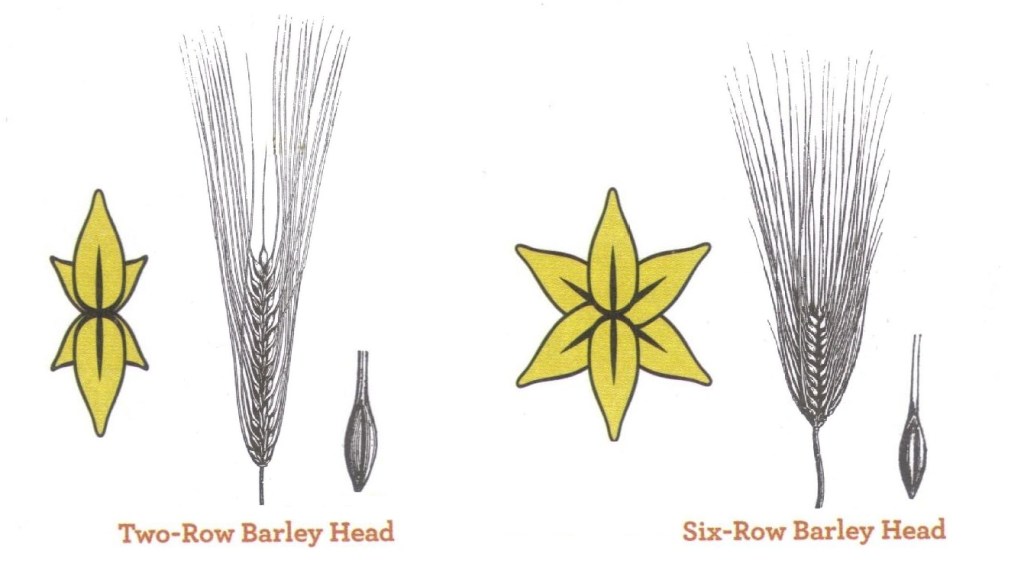
Figure : Two vs six row barley
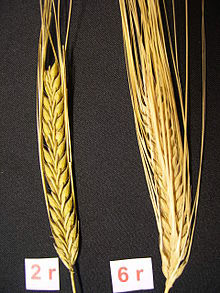
Figure : Two vs six row barley
Research indicates that a six-row barley species were used in period [Pretty]. However, medieval farmers were working with what was available and did not have the benefit of modern horticulture as we do today.[Caleb] Two row barley was know in period, as it has been available since Neolithic times [Komatsuda]
Two row barley has lower enzyme content, lower protein, greater starch content, and thinner husk make it better suited to higher extract. There are enough enzymes to convert the starches to sugar, and the lower protein content helps reduce hazing.
1 lb Breiss 2-row Victory malt – toasted
The toasting of the grains is to simulate the uneven temperatures in the medieval malting house. In a modern malting house all the grains are set at exactly the same temperature. This would not be possible in period. Grains would be malted at differing temperatures, which resulted in a wider range of colors.
Wheat and Oat adjuncts
1 lb wheat malt (2.3L)
1 lb oats (5-10L)
The use of wheat and oats in a medieval recipe is expected. These grains were readily available and provide a welcome boost to the flavor and density profiles of the resulting ale. As we see, however, their use is judicious. The low ratios of these adjuncts too the primary barley grist in the grain bill is most likely due to the adverse affects they impart at higher volumes. Wheat and oats both have high protein contents. As previously discussed, these proteins lead to clogged or stuck mashes and hazy beer.
Wheat in period brewing
A site in the Zagros Mountains of western Iran has yielded the earliest botanical evidence of beer making, dated to about 3500 B.C.1 Two-branch barley was cultivated in northeast Mesopotamia as early as 7000 B.C. After 6000 B.C. it moved south and changed into six-branch barley. A residue of six-row barely turned up in a vessel, dated to the late fourth millennium B.C., from a Lower Mesopotamian site. It, along with emmer, a type of wheat, was the principal ingredient of beer. [Unger]
Hildegard of Bingen, the twelfth century abbess of Rupertsberg, urged the use of beer made from barley or wheat in the treatment of lameness. [Unger]
Wheat has been used in brewing from the beginning, and throughout history. At lower percentages (5 to 20 percent) of the grist, wheat malt can be added to any number of beer styles — including British ales — to enhance the head retention without clarity problems.[Frane] It is therefore expected that a certain amount of wheat would find its way into our English Housewife’s Ordinary.
Oats in period brewing
Figure : Plan of the monks’ bake and brewhouse from the St. Gall Monastery Plan, c. 820, with the brewery on the left indicated by the label hic fribus conficiat ceruisa, that is, “here let the beer for the brothers be brewed.” Reprint from Walter Horn and Ernest Born, The Plan of St. Gall: A Study of the Architecture and Economy of, and Life in a Paradigmatic Carolingian Monastery, 3 vols. (Berkeley: University of California Press, 1979), 2: 254.
The St. Gall Monastery Plan, drawn up about 820 AD, offered a model for Carolingian religious administrators to follow in spreading reformed Benedictine monasticism, an essential part of the political program of Charlemagne (see ). The Plan lays out all the features essential to a monastery and prominent among them are three breweries, the oldest in Europe about which anything is known. One brewery produced beer for the guests, a second for the brothers in the monastery, and the third for pilgrims and the poor. The guests, noblemen, and royal officials got a better beer, made from wheat and barley, while the others had to be satisfied with beer made from oats. [Unger]
On the amount of adjuncts to use
Having therefore ground eight bushels of good malt upon our quern, where the toll is saved, she addeth unto it half a bushel of wheat meal and so much of oats small ground, and so tempereth or mixeth them with the malt that you cannot easily discern the one from the other; otherwise these latter would clunter [clot], fall into lumps, and thereby become unprofitable.[Markham]
This indicates an 8:1 ratio of barley to adjuncts, and a 1:1 ratio of wheat to oats.
A note on weights and measures
Our Housewife ground 8 bushels of “good“ malt (pro tip: don’t use bad malt!) BUT – What is a bushel? Period measurements are all over the place. Outside research shows [T]he density of malt at the time was in fact 0.49 g/cc, that means that a bushel of malt could contain 17,055.0 grams of malt, or 37.6 pounds.[Olsen].
What we think of as a standard imperial gallon is not the same as in period. In period, volumes and weights seemed interchangeable.
And surely, evil Custome seemeth to have brought up three such distinct measures (and which the foresaid Mr. Wingate hath also expressed to me) For at the Guild-Hall in London, where is generally holden to be the true Standard for these Measures, and so from which all others of the like kind throughout the Kingdome, are usually derived, there are but two such distinct Measures only (as we have been there informed for a certain truth) viz, one for Wines (and so for strong-waters, oiles, and the like) and the other for Ale, Beer, and drie things, as Corn, Coales, Salt and the like; which latter is commonly called the Winchester Measure, and from this are taken the bigger drie Measures, as the half-Peck and Peck, and so on to the Bushell, which is the greatest of our drie Measures [Wyband]
Botanicals
1oz Hallertau Mittelfrüh hops
Hops in period brewing:
Use of hops in beer spread slowly around the Medieval world. Though hopped beer was known in Britain as early as the 10th century (Wilson 1975), it did not become common throughout England until the turn of the 16th century (Monckton 1966). Once established in their country, however, the English, along with the Dutch and the Germans, took hopped beer (and consequently hop cultivation) with them throughout their empires. [DeLyser &Kasper]
Hops were in ever increasing demand as the English hopped beer industry developed. Through the port of Antwerp, and also through Bergen-op-Zoom, high-quality hops from Brabant and the Land of Heusden made their way across the North Sea. Exports to England began around 1438. Quantities were originally small but grew significantly over the course of the fifteenth century.[Behre]
Our recipe calls simply for “hops”, without any varietal designation. It stands to reason that hops being imported from and through the Netherlands would include noble hop varieties and derivatives, and it would be these hops that were available to our English housewife.
The types of noble hops are Hallertauer, Saaz, Spalt, and Tettnanger. These are all landacre varieties, meaning they grow wild in their home regions. These are the basis for most modern cultivated hop varieties.
On the amount of hops to use
“The continuance of the drink is always determined after the quantity of the hops, so that, being well hopped, it lasteth longer. For it feedeth upon the hop and holdeth out so long as the force of the same continueth, which being extinguished, the drink must be spent, or else it dieth and be-cometh of no value.”[Harrison]
Why a noble hop and not Kent Goldings or Fuggles?
Hops were introduced to England by Flemish farmers as early as 1300. However, various “Golding” types can be traced back to the 1790s and Fuggle was propagated by Richard Fuggle in 1875. [Peacock]
Yeast
Nottingham Ale Yeast
Water
Water pH – 7.93
Water TDS – 158
The local tap water is fairly hard. A teaspoon of gypsum was added to the mash water. The town drinking water report is available online.2
Additional ingredients
1oz American Oak Infusion Spirals – Light Toast
Conditioning tablets (1 per bottle)
Aesthetics
This beverage is to be presented in a period container as depicted below.
Illustration 1: Pitcher and mug
After the Roman occupation of Britain, pottery continued to be made using the terra sigillata technique introduced by the Romans until the Medieval period(after the Norman conquest) when lead glazing and slip trailed pottery began to be produced. These 4 jugs depicted below, from SE England are typical of pottery of the period. During this period, potters had little social status and pottery was little more than utilitarian. Pottery was not widely used for eating, as wooden plates and bowls were preferred. Pots were used for serving, storing, or preparing foods, and large pitchers for ale, beer, milk and water were common household staples. [GCC]
Illustration 2: 4 Medieval Pitchers, Earthenware with Slip Decoration, SE England, 1150-1300 CE
Process and Notes
used somewhat more modern methods to recreate this ale.
- Grains were hand milled to grist to allow the husks to remain intact but the germ to be slightly cracked and split. The mill was calibrated to the width of a credit card (.0299 inches, or .76 millimeters).
Figure 4: Grains in the mill
Illustration 4: Grains before milling
Illustration 3: Grains after milling
- To simulate grain being malted in a medieval malthouse, where temperature control would not be as precise as today, a pound of the grain was toasted 350F for 15minutes.
Figure 6: Grains before toasting
Figure 5: Grains after toasting - Rather than adding water to the grist, I added the grist to the water to prevent clumping and a stuck mash, which is more likely with the wheat and oat adjuncts. The local tap water is fairly hard. A teaspoon of gypsum was added to the mash water.
Figure 7: Wort removed prior to the boil - To approximate barm from a previous batch, I removed and cooled 2 cups of wort from the mash tun and added the prepackaged ale yeast. This was allowed to rise while the wort boiled and cooled.
- The hops were added at 60 minutes (beginning of boil).
- Once forced-chilled using a wort chiller, the cooled wort was added to a 6 gallon glass carboy, the yeast was pitched.
- An oak spiral was added to simulate oak barrel aging, and an airlock was attached. This stood for several weeks while the ale fermented and cleared.
- This ale is bottle conditioned, which might simulate conditioning in a hogshead on a small scale.
The local tap water is fairly hard. A teaspoon of gypsum was added to the mash water.
No yeast nutrient was used.
Strike temp: 165F
Mash temp: 156F
Mash duration: 90 minutes
SG 1.073
FG 1.010
ABV ~8.2%
Notes on barley:
- Barley (Hordeum vulgare) is an annual grass featuring erect stems with few, alternate leaves. Barley comes in two varieties, distinguished by the number of rows of flowers on its flower spike. Six-row barley has its spike notched on opposite sides, with three spikelets at each notch, each containing a small individual flower, or floret, that develops a kernel. Two-row barley has central florets that produce kernels and lateral florets that are normally sterile. Whereas six-row barley has a higher protein content and is more suited for animal feed, two-row barley has a higher sugar content and is thus more commonly used for malt production. [Britannica]
- The majority of modern seed sources offer only a few select cultivars of wheat that are bred to exhibit specific, desirable traits. Medieval agriculturists, on the other hand, were not working with stable cultivars. Rather, the seeds they used were called landraces, which are distinct ecotypes uniquely adapted to a particular environment. Each field of medieval grains would have had evolved in the truest Darwinian sense to reflect its particular location. In our modern artisanal-food diction, medieval landraces had true terroir. [Caleb
- Hulled six-row species of barley predominated, namely the lax-eared nodding bere of berecorn and the dense eared erect type, but an early ripening variety known as haste or haste-bere was also cultivated.[Pretty]
Fermentation process
Yeast was pitched on Friday, May 19. The starting Specific Gravity was high at 1.073. I had expected fermentation to take about 14 days. By Monday, May 22 the SG was down to 1.011. I decided to let it sit for another week (War of the Roses was the following weekend).
Figure 8: Tilt report on this brew.
Text reference to Harrison:
Harrison:
“p137-138
Having therefore ground eight bushels of good malt upon our quern, where the toll is saved,? she addeth unto it half a bushel of wheat meal and so much of oats small ground, and so tempereth or mixeth them with the malt that you cannot easily discern the one from the other; otherwise these latter would clunter [clot], fall into lumps, and thereby become unprofitable. The first liquor
-which is full eighty gallons, according to the proportion of our furnace-she maketh boiling hot and then poureth it softly into the malt, where it resteth (but without stirring) until her second liguor be almost ready to boil. This done, she letteth her mash run till the malt be left without liquor, or at the leastwise the greatest part of the moisture, which she perceiveth by the stay and soft issue thereof; and by this time her second liquor in the furnace is ready to seethe, which is put also to the malt, as the first wort also again into the furnace, whereunto she addeth two pounds of the best English hops and so letteth them seethe together by the space of two hours in summer or an hour and an half in winter, whereby it getteth an excellent color and continuance without impeachment or any superfluous tartness. But before she putteth her first wort into the furnace or mingleth it with the hops, she taketh out a vesselful, of eight or nine gallons, which she shutteth up close and suffereth no air to come into it till it become yellow, and this she reserveth by itself unto further use, as shall appear hereafter, calling it brackwort or charwort,25 and as she saith, it addeth also to the color of the drink, whereby it yieldeth not unto amber or fine gold in hue unto the eye. By this time also her second wort is let run; and, the first being taken out of the furnace and placed to cool, she returneth the middle wort unto the furnace, where it is stricken [laded] over, or from whence it is taken again when it beginneth to boil and mashed the second time, whilst the third liquor is heated (for there are three liquors), and this last put into the furnace when the second is mashed again. When she hath mashed also the last liquor (and set the second to cool by the first), she letteth it run and then seetheth it again with a pound and an half of new hops, or peradventure two pounds, as she seeth cause by the goodness or baseness of the hops; and when it hath sodden [boiled], in summer two hours and in winter an hour and an half, she striketh it also and reserveth it unto mixture with the rest when time doth serve therefor. Finally, when she setteth her drink together, she addeth to her brackwort or charwort half an ounce of orris and half a quarter of an ounce of bayberries finely powdered, and then, putting the same into her wort, with an handful of wheat flour, she proceedeth in such usual order as common brewing requireth. Some, instead of orris and bays, add so much long pepper only, but in her opinion and my liking it is not so good as the first, and hereof we make three hogsheads of good beer, such (I mean) as is meet for poor men as I am to live withal, whose small maintenance (for what great thing is £40 a year, computatis computandis [taking everything into account], able to perform?) may endure no deeper cut, the charges whereof groweth in this manner. I value my malt at ros., my wood at 4s. (which I buy), my hops at rod., the spice at 2d., servants’ wages, 2s. 6d., with meat and drink, and the wearing of my vessel at zod., so that for my os. I have tenscore gallons of beer or more, notwithstanding the loss in seething, which some being loath to forgo do not observe the time and therefore speed thereafter in their success, and worthily. The continuance of the drink is always determined after the quantity of the hops, so that, being well hopped, it lasteth longer. For it feedeth upon the hop and holdeth out so long as the force of the same continueth, which being extinguished, the drink must be spent, or else it dieth and be-cometh of no value.
”
What to do next time:
- For conditioning, save an amount of the wort prior to pitching the yeast. After fermentation, use this as conditioning sugar. It would be advisable to put this wort in a glass carboy/gallon jug with an airlock. It would be necessary to adjust the grain bill accordingly.
References
Markham, Gervase. The English Housewife. United Kingdom, McGill-Queen’s University Press, 1994.
Harrison, William. The Description of England: The Classic Contemporary Account of Tudor Social Life. United Kingdom, Folger Shakespeare Library, 1994.
American Homebrewers Association – Zymurgy Magazine Two-Row vs Six-Row Barley https://www.homebrewersassociation.org/zymurgy/zymurgy-extra-2-row-vs-6-row-barley/
Britannica, T. Editors of Encyclopaedia (2023, March 31). barley. Encyclopedia Britannica. https://www.britannica.com/plant/barley-cereal
Leech, Caleb, Managing Horticulturist, The Met Cloisters, Survival and Adaptation: Bonnefont’s Corne Field. June 23, 2016 https://www.metmuseum.org/blogs/in-season/2016/corne-fields
Pretty, J. N. (1990). Sustainable Agriculture in the Middle Ages: The English Manor. The Agricultural History Review, 38(1), 1–19. http://www.jstor.org/stable/40274710
Unger, R. W. (2004). Early Medieval Brewing. In Beer in the Middle Ages and the Renaissance (pp. 15–36). University of Pennsylvania Press. http://www.jstor.org/stable/j.ctt3fj2zx.8
Frane, Jeff Brewing With Wheat, Brew Your Own Magazine, September 1996
D. Y. DeLyser, & W. J. Kasper. (1994). Hopped Beer: The Case for Cultivation. Economic Botany, 48(2), 166–170. http://www.jstor.org/stable/4255609
Behre, K.-E. (1999). The history of beer additives in Europe — a review. Vegetation History and Archaeobotany, 8(1/2), 35–48. http://www.jstor.org/stable/23417641
Olsen, Peter. On the Quarter of Malt and the Hogshead of Beer – Self-published, 2012
https://docs.google.com/document/d/1p6K3vqx2S-9rMioKimfab4kcURiFbKoX1RCuMIHr7jM/edit
Peacock, Val, The Oxford Companion to Beer definition of English hops. Craft Beer and Brewing https://beerandbrewing.com/dictionary/Kt199IKhon/
Glendale Community College – Art 198 – History Of World Ceramics – http://www-01.glendale.edu/ceramics/medievalpitchers.html
1Here the text marks an endnote: “William Harrison was just such a good man; his wife also derived three hogsheads of beer (“tenscore [200] gallons of beer or more”) from a quarter of malt (eight bushels). Harrison’s wife followed the same steps in making beer as Markham recommends, with some slightly more complex variations. Harrison’s description of the process (too long to quote) is both detailed and informative (see Harrison, pp. 137-8).”. This document contains Harrison’s description in the notes section.
2Town of Esopus Annual Drinking Water Report http://www.esopus.com/water/pe-aws-2021.pdf


Leave a Reply