Making period medicines from common garden plants.
© 2024 William C. Johnston, all rights reserved
Summary
The document is about recreating medieval medicines using common garden plants and mead as a carrier for infusions and decoctions.
Introduction
In the Middle Ages, herbs, flowers, and perfumes were essential in everyday life, with over 600 plants used for medicinal purposes. Dioscorides’ Materia Medica, written in 65 AD, formed the basis of herbal medicine until 1500. Bald’s Leechbook and Dodoens’ Niewe herball (History of plants) are based on this work.
The Sources
Bald’s Leechbook and an in-period translation of Doeden’s Niewe Herball are the primary sources for this work.
Approach
In the project, medicines were created from locally foraged plants and researched for their medicinal properties. Decoctions were made using a coffee siphon to extract essential medicinal effects.
Ingredients
The author foraged plantain and mugwort, grew sage, brewed mead with local honey. Barley husks removed.
The Medicines
This section discusses various medieval remedies for ailments such as earaches, toothaches, foot aches, fevers, and carbuncles.
The remedies include earache salve, a toothpaste, toothache salve, foot ache remedy, fever remedy, a carbuncle remedy, and more.
Instructions for preparing and applying the remedies are detailed from medieval manuscripts.
The Mead used for infusions and decoctions
The process of making basic mead using raw honey, yeast dregs, and specific brewing techniques is detailed.
Introduction
“Herbs, flowers, and perfumes formed a large part of everyday life in the Middle Ages and were inextricably linked with magic and medicine. Medicinal plants and herbs were an important and major part in the pharmacopeia. Medicines were made from herbs, spices, and resins. … Some plants were used for specific disorders, while others were credited with curing multiple diseases. In many cases, preparations were made of many different herbs.” (Hajar)
This project attempts to recreate a number of these remedies.
The Sources
Recipes in this project were taken primarily from two sources: Bald’s Leechbook, and Dodoens’ Niewe Herball.
Bald’s Leechbook
“The Leechbook of Bald is an Old English medical text probably compiled in the ninth-century, possibly under the influence of Alfred the Great’seducational reforms. It takes its name from a Latin verse colophon at the end of the second book which begins Bald habet hunc librum Cild quem conscribere iussit, meaning ‘Bald owns this book which he ordered Cild to compile.’ The text survives in only one manuscript: London, British Library, Royal MS 12, D xvii.” (Norman)
Niewe herball, or historie of plantes
The full title: “A new herball, or, Historie of plants : wherein is contained the whole discourse and perfect description of all sorts of herbes and plants : their diuers and sundrie kindes : their names, natures, operations, & vertues : and that not onely of those which are heere growing in this our countrie of England, but of all others also of forraine realms commonly used in physicke, First set foorth in the Douch or Almaigne toong / by that learned D. Rembert Dodoens … and now first translated out of French into English, by Henrie Lyte, Esquier.”
Dodoens, Rembert, 1517-1585
Lyte, Henry, 1529?-1607 , translator
This translation first published in 1578.
Lyte’s English translation was based on l’Ecluse’s French translation of Dodoens Cruydeboeck rather than the original.
A New Herball, or Historie of Plants was published in multiple editions and various translations and it remained a widely used botanical guide for more than 200 years. Rather than emulating Leonhard Fuch’s work which organised plants alphabetically, Dodoens arranged his into the categories species, form, name, virtue, and temperament.
Approach
Medicines in this project were derived by finding what plants could be locally foraged, researching the medicinal properties of these plants, and creating the period medicines from the recipes. During the research, some recipes surfaced that were too simple to not recreate, even if that meant using commercially sourced ingredients, such as the cinnamon in the toothache salve. Additionally, some ingredients were at hand already, such as the barley and salt in the toothpaste”.
Decoctions were done using a coffee siphon, in lieu of a medieval pelican or distillation without a license, which is illegal in every state as of this writing. The principles are the same in that both devices will recirculate a liquid over the herbs and plant material to extract the essential medicinal effects.
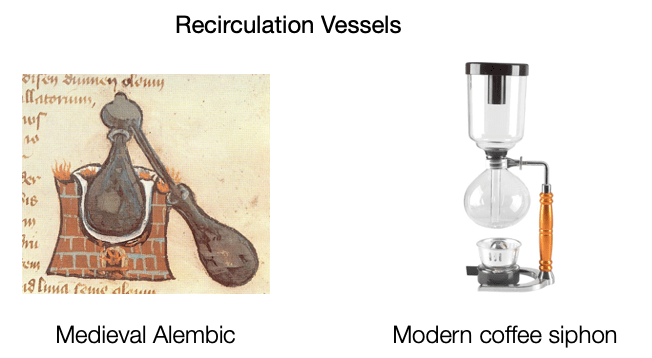
Research shows that any type of mixing the herbs into any type of liquid would be expected to extract the medicinal elements of the material. Alcoholic beverages were commonplace in period, so one was created and used for these recipes; mead in this case.
“It appears that no distinction was made between the expected medical effects of herbs or other materials fermented into mead (or wine, or ale), versus macerated or boiled in the drink after fermentation, or between extraction Ito alcohol versus water or with or without heat.” (Angotti)
Ingredients
The plantain and mugwort were foraged, the sage was garden grown by the author, and the mead was brewed with local honey by the author. Cinnamon, beeswax, barley, and oils were purchased commercially. The barley was purchased for brewing ale, and therefore had its husks intact. The husks were removed in order to create the tooth scrub.
Barley was milled on a quern, the chaff was separated, and the meal sifted from the flour to be used in the toothpaste recipe.
The Medicines
These remedies were selected as a sampling from across several medieval manuscripts. On display are:
- An earache salve
- A toothpaste
- A toothache salve
- Foot ache remedy
- For issues of the blood
- Fever Remedy
- For pain in bowels
- Carbuncle remedy
- “For matter in the neck”
- Headache remedy with wine and sage
- For perilous childbearing, drink spearmint in wine.
An earache salve
Leechbook Book I Ch. iii ph2, pg 41
Onion
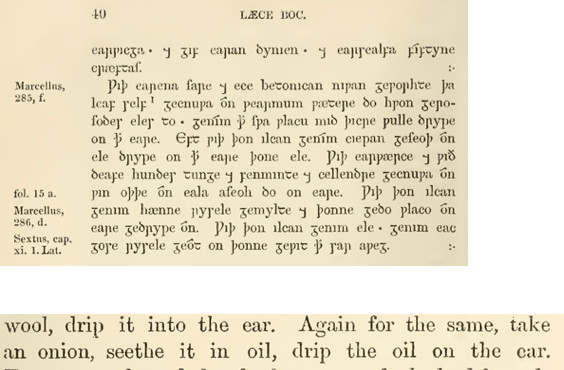
For sore an d ache of ears, pound new wrought betony, the leaves themselves, in warm water, add a somewhat of rose oil, take that lukewarm with thick wool, drip it into the ear. Again for the same, take an onion, seethe it in oil, drip the oil on the ear. For ear wark and for deafness, pound the herb hounds tongue^ and fenmint^ and coriander in wine or in ale, strain it, apply to the ear. For the same, take hen grease, melt it, and then apply it lukewarm to the ear, drip it on it. For the same, take oil, take also goose grease, pour into the ear, then the sore departs.
A toothpaste
Bald’s Leechbook Book I Ch. v ph5, pg 51
Barley, honey, and salt
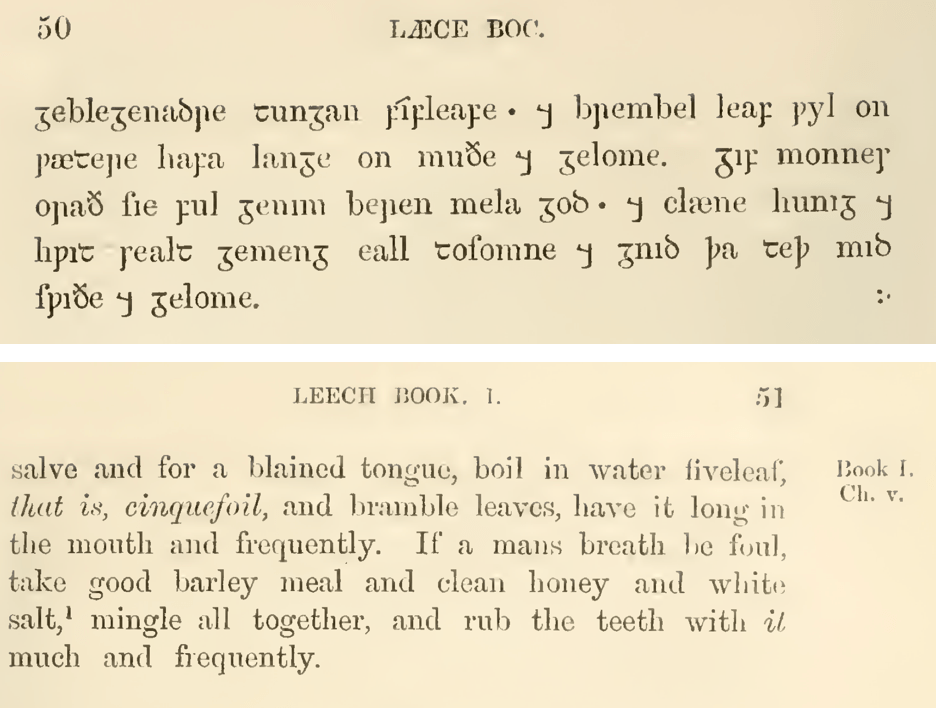
If a mans breath be foul, take good barley meal and clean honey and white salt,’ mingle all together, and rub the teeth with it much and frequently.
The barley meal was milled by the author of a quern. The chaff was (mostly) separated from the meal using a “toss and catch” method.
A toothache salve
Bald’s Leechbook Book I Ch. vi ph2, pg 53
Cinnamon, honey, and pepper
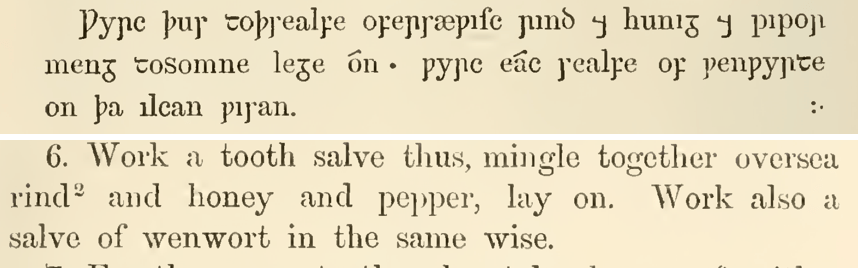
Work a tooth salve thus, mingle together oversea rind and honey and pepper, lay on.
The honey used was locally sourced wildflower honey. Cinnamon and pepper were store bought, emulating the spice trade.
Foot ache remedy
Bald’s Leechbook Book I Ch. xxvii ph2, pg 69
Mugwort
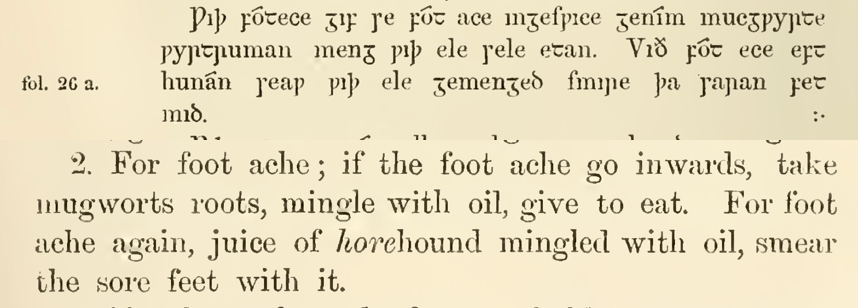
For foot ache ; if the foot ache go inwards, take mugworts roots, mingle with oil, give to eat. For foot ache again, juice of horehound mingled with oil, smear the sore feet with it.
For issues of the blood
Niewe herball, Dodoens, Rembert, 1517-1585 pg 93
Plantain

The decoction of leaves of plantayne drunken, stoppeth the blouddy slice and other fluxes of the belly, also it stoppeth the spiitting of bloud, the pissing of bloud, and the superfluous flowing of womens termes, and all other issue of bloud.
Seems like they favored plantain for blood ailments

The same juice of the Decoction of the leaves or rootes of Plantayne, Do cure and heale the naughtie ulcers of the mouth, the tooth ache, and the bleeding of the gummes or jawes, whan the mouth is oftentimes wasshed with the same.
A medieval treatment for gingivitis. In this case we used the leaves, and saved the roots for the fever remedy below.
Fever Remedy
Niewe herball, Dodoens, Rembert, 1517-1585 , pg 93

Plantain
A decoction of wine/mead and dried plantain roots was used to cure fever:
“Some have written, that three rootes of Plantayne, taken with wine and water doth cure fever tertian: and foure roots so taken do cure the fever quartayne.”
We went all out and used four roots.
For pain in bowels
Gold and Sweet, Ensnaring: Mead in Great Britain Prehistory to Elizabeth I, Angotti, pg 186
Mugwort
“Medicines mixed into alcoholic drinks post fermentation are much more common than medicinals fermented into mead.” (Angotti)
Angotti shows that the Harley Manuscript number 5394 details a mugwort decoction was used to treat “pain in the bowels”.
Unfortunately, the Harley Collection is housed at the British Library, which suffered a cyber attack in October 2023. The manuscripts remain unavailable online.
Wild mugwort was foraged, cleaned, dried, and decocted using home crafted mead. The decoction was done using a coffee siphon, to replicate the use of a medieval pelican.
Carbuncle Remedy
Bald’s Leechbook Book I Ch. lxxi ph1, pg 359
Sage and honey
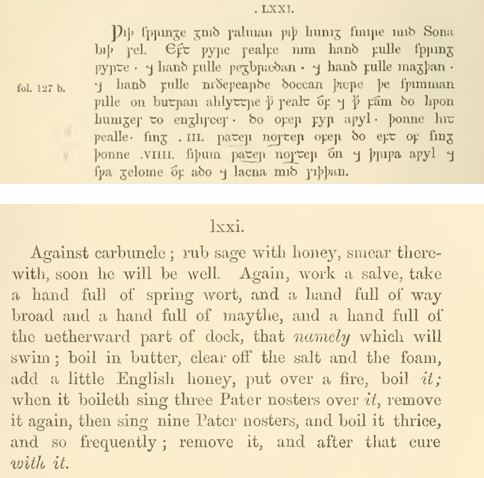
Against carbuncle; rub sage with honey, smear therewith, soon he will be well.
Sage was grown in the author’s garden and rubbed with locally sourced wildflower honey.
For matter in the neck
Bald’s Leechbook Book I Ch. v ph6, pg 49
Rose Blossoms
Leechdoms against a purulent humour in the neck, and tokens of it, whether it be such, and also for wellings in the jowl and throat and weasand, and against quinsy. Fourteen receipts.
6. For matter in the neck, take wax and oil, mingle with rose blossoms and melt together, put this thereon.
Bald’s Leechbook makes mention of “oil” 119 times, but is not specific on which type of oil. Here we use olive oil to recreate the remedy.
Headache Remedy
Niewe herball, Dodoens, Rembert, 1517-1585, pg 252

Sage
Sage boyled in wine and dronken provoketh brine, breaketh the stone, comforeth the Harte, and swageth head ache
For this remedy, sage was decocted with mead and set aside to cool before drinking.
For perilous childbearing
Niewe herball, Dodoens, Rembert, 1517-1585, pg 246
Mint

“Mynte boyled in wine and dronken, easeth women which are tomuch grieved with harde and perillous travell in childbearing.” The Mead used for infusions and decoctions
Brewer: Carrick MacSeáin
Recipe Source: Tractatus de Magnetate et Operationibus Eius Folio 20r
Recipe Name: Basic mead
In Gold and Sweet, Ensnaring: Mead in Great Britain Prehistory to Elizabeth I, Angotti states: “Mead (as well as wine and ale), in addition to having its own character was often used as a carrier for medicines, the plain drink adulterated to produce a medicinal beverage. Maceration (extraction by soaking a solid) and boiling were both common techniques. In MS.MSL.136, wine (76 uses) is the most common alcoholic medicine carrier followed by ale (44 uses); mead is used only three times.” (Angotti)
The decoctions, infusions, and tisanes created for this project were done with a mead produced by the author. The redaction below details the process by which that mead was made.
Original Recipe:
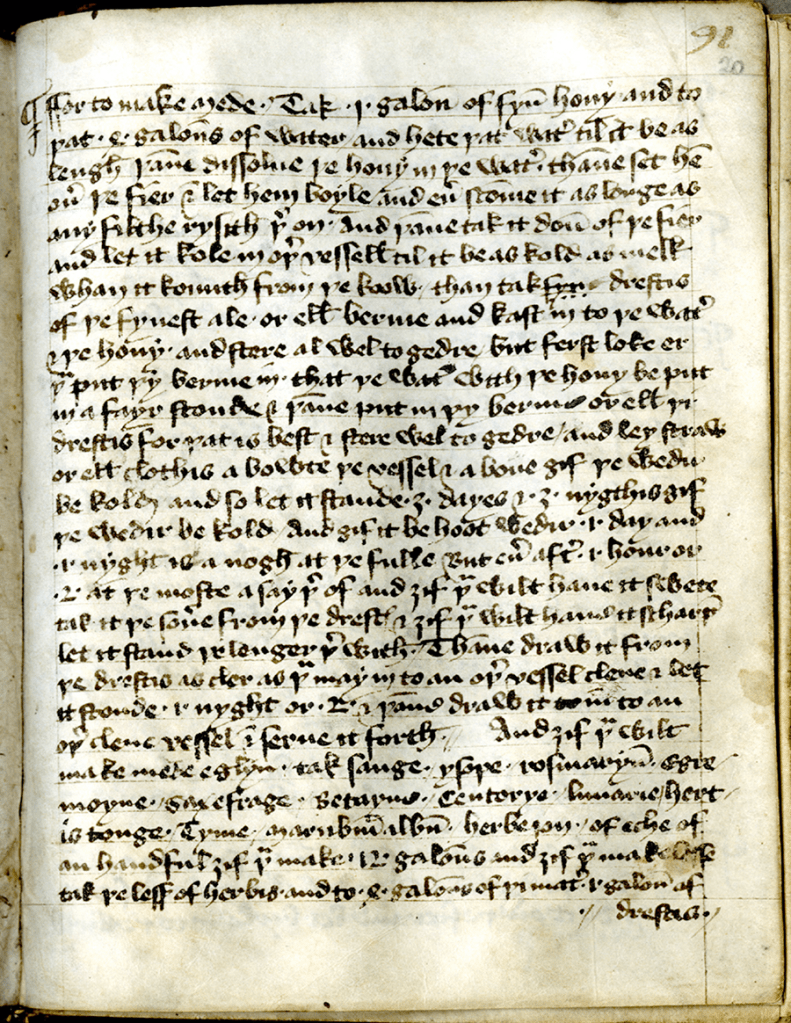
//ffor to make mede. Tak .i. galoun of fyne hony and to þat .4. galouns of water and hete þat water til it be as lengh þanne dissolue þe hony in þe water. thanne set hem ouer þe fier & let hem boyle and ever scomme it as longe as any filthe rysith þer on. and þanne tak it doun of þe fier and let it kole in oþer vesselle til it be as kold as melkwhan it komith from þe koow. than tak drestisof þe fynest ale or elles berme and kast in to þe water& þe hony. and stere al wel to gedre but ferst loke er þu put þy berme in. that þe water with þe hony be put in a fayr stonde & þanne put in þy berme or elles þi drestis for þat is best & stere wel to gedre/ and ley straw or elles clothis a bowte þe vessel & a boue gif þe wedir be kolde and so let it stande .3. dayes & .3. nygthis gif þe wedir be kold And gif it be hoot wedir .i. day and .1. nyght is a nogh at þe fulle But ever after .i. hour or .2. at þe moste a say þer of and gif þu wilt have it swete tak it þe sonere from þe drestis & gif þu wilt have it scharpe let it stand þe lenger þer with. Thanne draw it from þe drestis as cler as þu may in to an oþer vessel clene & let it stonde .1. nyght or .2. & þanne draw it in to an oþer clene vessel & serve it forth//
Redaction:
For to Make Mead
Dissolve 1 gallon of honey in 4 gallons of water. Boil for as long as the scum rises. Remove to a clean vessel. Allow it to cool until it is the temperature of milk from the cow. Add the lees of ale or barm. Cover with cloth or straw. After a few days remove from lees. Allow it to stand for a day or two, then serve.
- This mead was brewed using raw honey
- I pitched two cups of the dregs of a previous batch as yeast for this recipe. That batch used Lavlin D47.
- Contrary to my usual method, but in accordance with this process, I boiled the honey and skimmed the foam as it rose. “scomme it as longe as any filthe rysith per on”
- The recipe specifically states that it is important that the vessel be clean, and that the vessel be covered with cloth. Instead of an open tub covered with cloth, this batch fermented in a sanitized glass carboy with an air lock.
- Although the recipe implies that this mead was meant to be consumed in a couple of days, this batch of mead has been allowed to fully ferment and age for 2 months in the fermenter. The batch then aged an additional 6 months in the bottle, as allowed by the recipe:
- .2. at þe moste a say þer of and gif þu wilt have it swete tak it þe sonere from þe drestis & gif þu wilt have it scharpe let it stand þe lenger þer with.
Ingredients
15 pounds of raw honey
yeast dregs (originally Lavlin D47)
Process
Water for 5 gallons was heated to boiling. Added to the boiling water was the honey. Boiling continued, and the froth was skimmed until very little foam surfaced. At that time, the heat was removed and the must was cooled using an immersion wort chiller – cold water runs through coiled copper – until the must was at 70℉. At this time the must was transferred to a 5 gallon glass carboy. A Tilt hydrometer was added. This was left to ferment at 75℉ until the specific gravity reached 1.014. The mead was then racked to a secondary fermenter after 1 months, where it sat for an additional 1 month.
Bibliography
The Leechbook of Bald,
One of the Oldest Medical or Scientific Treatises Written in English Circa 900CE, Jeremy Norman’s HistoryofInformation.com
Wikipedia contributors. (2023, December 27). Alembic. In Wikipedia, The Free Encyclopedia. Retrieved 15:38, August 22, 2024, from https://en.wikipedia.org/w/index.php?title=Alembic&oldid=1192014125
The Air of History (Part II) Medicine in the Middle Ages
Rachel Hajar, M.D.
Department of Cardiology, Heart Hospital, Hamad Medical Corporation, Doha, Qatar
British Library Medieval Manuscripts Blog, Bald’s Leechbook Now Online 05 January 2016
https://blogs.bl.uk/digitisedmanuscripts/2016/01/balds-leechbook-now-online.html
A full translation of Bald’s Leechbook is contained in *Leechdoms, Wortcunning, and Starcraft of Early England*, ed. by O. Cockayne, Rolls Series, 3 vols (London: Longmans, 1864-66), vol II (1864) https://archive.org/details/leechdomswortcun02cock
Niewe herball, Dodoens, Rembert, 1517-1585
http://resource.nlm.nih.gov/2232003R
A Collection of Remedies
Date: Mid 15th century
Reference: The Wellcome Collection , 183 Euston Road, London NW1 2BE UK https://wellcomecollection.org
MS.MSL.136 https://wellcomecollection.org/works/md9rpgmh
Laura Angotti, 15th Century English Mead: Initial Review of Hydromel, Metheglin, and Melomel Recipes in Wellcome MS.MSL.136, 2021, https://www.academia.edu/50678535/15_th_Century_English_Mead_Initial_Review_of_Hydromel_Metheglin_and_Melomel_Recipes_in_Wellcome_MS_MSL_136
Laura Angotti, Gold and Sweet, Ensnaring: Mead in Great Britain Prehistory to Elizabeth I, ISBN 10: 1732464626 / ISBN 13: 9781732464629
Published by Mt. Gilboa Miscellany, 2024
Original recipe: The University of Alabama at Binghamton Reynolds-Finley Historical Library
https://library.uab.edu/locations/reynolds/collections/medieval-renaissance-manuscripts/tractatus/folio-20r
 Carrick of Nordenhal
Leave a comment