Brewer: Carrick MacSeáin, OSW
Recipe Source: The Closet of Sir Kenelm Digby Knight Opened
Recipe Name: Stepponi
Original Recipe:
TO MAKE STEPPONI
Take a Gallon of Conduit-water, one pound of blew Raisins of the Sun stoned, and half a pound of Sugar. Squeese the juyce of two Limons upon the Raisins and Sugar, and slice the rindes upon them. Boil the water, and pour it so hot upon the ingredients in an earthen pot, and stir them well together. So let it stand twenty four hours. Then put it into bottles (having first let it run through a strainer) and set them in a Cellar or other cool place.
Redaction:
Gallon of Conduit-water – I used water from a local spring. I am using the wine gallon as the measure here. (124.16 oz)
one pound of blew Raisins of the Sun stoned, My interpretation here is that the raisins were soaked for some time so that they swelled up.
half a pound of Sugar.
Squeese the juyce of two Limons upon the Raisins and Sugar, and slice the rindes upon them. Boil the water, and pour it so hot upon the ingredients in an earthen pot, and stir them well together. So let it stand twenty four hours. Then put it into bottles (having first let it run through a strainer) and set them in a Cellar or other cool place.
For the earthen pot, I used a ceramic bean pot.
Recipe
1 Gallon* local spring water (124.16 oz)
1 pound sun dried raisins, soaked and deseeded (stoned) (Deseeded raisins will be basically smashed up a bit)
½ pound sugar
2 lemons
Boil the water
Juice the lemons, saving the rinds.
Slice the rinds of the lemons
In an earthen pot, add the sugar, raisins, and the juice and rinds of the lemons.
Pour the boiling water over the fruit and sugar mixture. Stir well.
Cover and let stand 24 hours
Strain and bottle.
Store in a cool dry place.
Period equipment
Earthen pot – A ceramic bean pot was used instead of an unglazed pot.
A period knife was used to slice the lemons and chop the raisins.
The liquid was strained through gauze weight linen.
The beverage is to be decanted from a period pitcher into a period drinking vessel. This handmade cup is reminiscent of a style that was common in Europe from not long after the fall of the Roman empire until at least the 17th century.
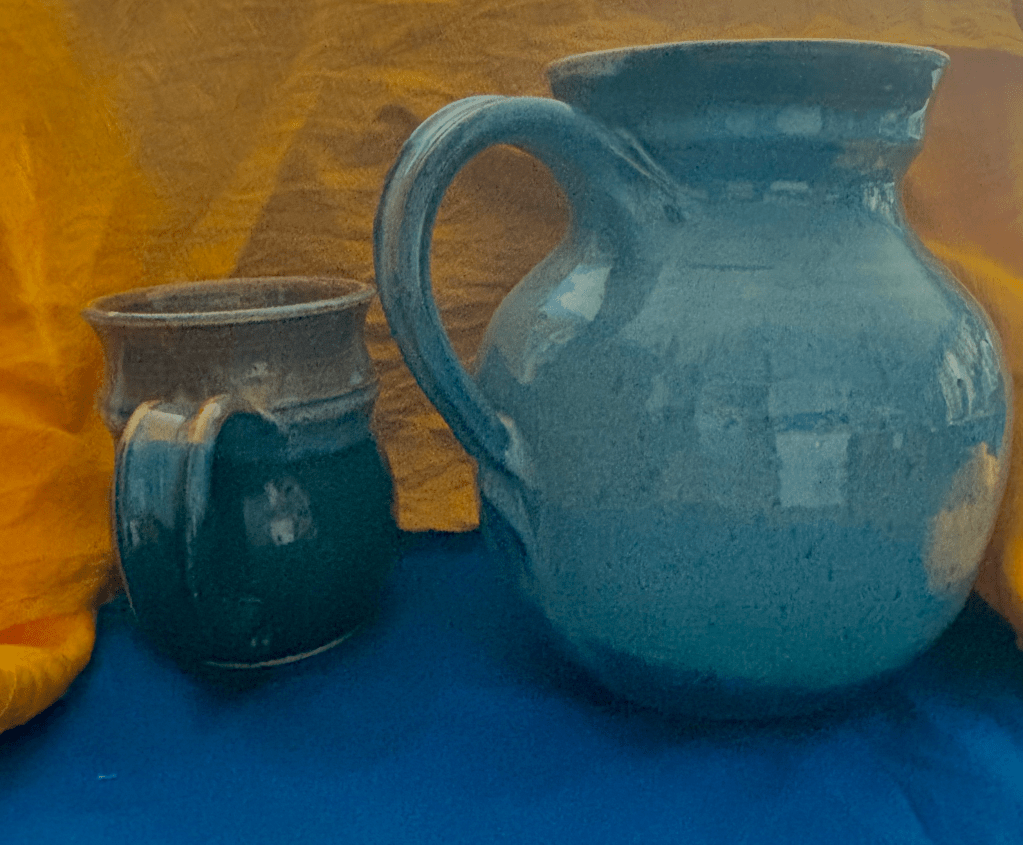
The handmade jug closely resembles one in the Metropolitan Museum of Art dated to 13th-14th Century France:
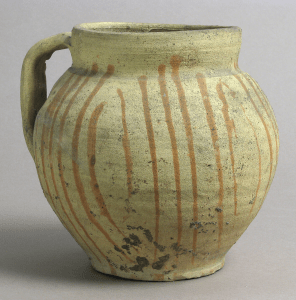
Title: Jar
Date: 13th–14th century
Culture: French
Medium: Earthenware with slip decoration
Dimensions: Overall: 6 5/8 x 7 1/8 x 6 1/16 in. (16.8 x 18.1 x 15.4 cm)
Classification: Ceramics
Credit Line: Gift of J. Pierpont Morgan, 1917
Accession Number: 17.194.2184
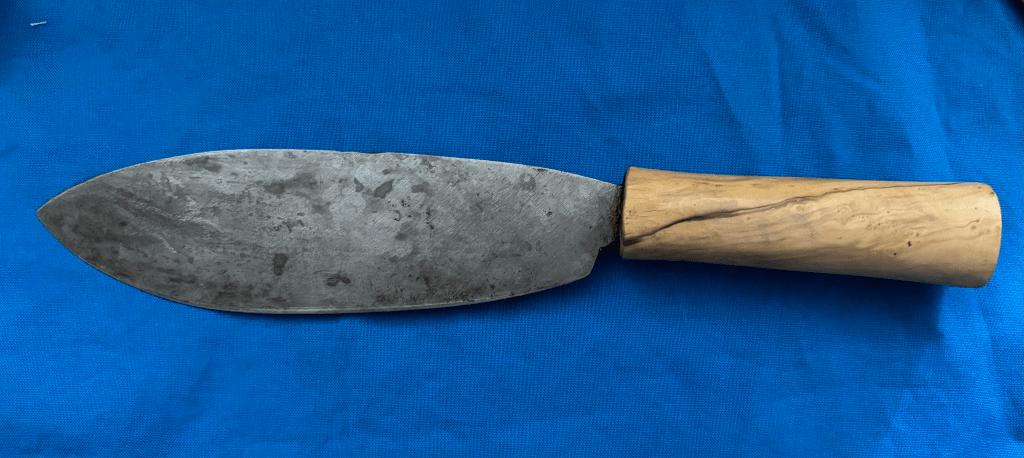
This is the description of the knife from the laurel that sold it to me at Pennsic:
Item: Cook’s Knife ca. 1300
Alloy: 5160
Wood: Boxwood
Finish: Flax Oil (Food-safe Linseed Oil)
This is an unusually historical offering, as close to period details as one can get without completely abandoning modern quality. It’s 1:1 with an extant medieval English cook’s knife dated ca. 1300, and uses the same wood: European boxwood, Buxus sempervirens.
This was the working servants tool, not a fancy piece for the nobility. The very rough polish was done on a water wheel. It is consistent with that • from working knives produced even today by practicing bladesmiths in non-industrialized countries, and is what I believe they would have used on the original knife. The handle wood is.
100-year-old boxwood. The handle is sealed using stand oil (a food-safe linseed oil).
The blade is a whittle-tang format, set using pine resin. The edge is fully sharp but left slightly rough, at a 400-grit finish. Certainly, expert sharpeners could bring a knife to a perfect edge even in the medieval period, but a working cook’s knife like this was less likely to get that sort of attention.
This particular blade was forged from 5160, a fully modern steel. The quality should greatly exceed that of the medieval artifact, but unobtrusively.If you cook medievally and you want to experience the closest approximation to the original tools you can find, this is the knife for you.
What to do next time
Next time I would chop the raisins better and soak them a bit longer. Too much of the water was absorbed by the raisins.
Water and measures
What we think of as a standard imperial gallon is not the same as in period. In period, volumes and weights seemed interchangeable. Beer and Ale gallons were different from wine/oils/dry gallons. I found no reference to which measure was used for water, but since beer and ale were separated from wine, but oils and dry measures were not, I am using the wine gallon as the measure here.
And surely, evil Custome seemeth to have brought up three such distinct measures (and which the foresaid Mr. Wingate hath also expressed to me) For at the Guild-Hall in London, where is generally holden to be the true Standard for these Measures, and so from which all others of the like kind throughout the Kingdome, are usually derived, there are but two such distinct Measures only (as we have been there informed for a certain truth) viz, one for Wines (and so for strong-waters, oiles, and the like) and the other for Ale, Beer, and drie things, as Corn, Coales, Salt and the like; which latter is commonly called the Winchester Measure, and from this are taken the bigger drie Measures, as the half-Peck and Peck, and so on to the Bushell, which is the greatest of our drie Measures [Wyband]
Dr. Wybard in his Tectometry, Page 289, doth suppose the Wine Gallon to contain but 224, or 225 Cubick Inches at the most.[The Mathematical Gazette] However, the modern gallon contains 231 cubic inches.[Olsen]
So a medieval wine gallon is 224/231, or 97%, of a modern gallon. 97% of 128oz is 124.16 oz (3.94 quarts).
Bibliography and Glossary
stoned – deseeded
blew – Old English blāwan, of Germanic origin; related to German blähen ‘blow up, swell’, from an Indo-European root shared by Latin flare ‘blow’.
Digby, Kenelm, The Closet of Sir Kenelm Digby Knight Opened, The Gutenberg Project, Anne MacDonell(editor)Release Date: August 5, 2005 [EBook #16441]
The Old Foodie: Raisins of all sorts. AGRUMED: Archaeology and history of citrus fruit in the Mediterranean – The history of Citrus in the Low Countries during the Middle Ages and the Early Modern Age – Publications du Centre Jean Bérard
John Ward, The Young Mathematician’s Guide (12th edition, 1771; ed. pr. 1707). [Per Miss F. A. Yeldham.]
Gleanings Far and Near. (1935). The Mathematical Gazette, 19(236), 340–354. http://www.jstor.org/stable/3606322
Wybard, J. “Setting Forth the Quantities of the Wine and Ale-gallons.” From Tactometria… London: Robert Leybourn. 1650. Web. PDF. Accessed 19 May 2911. <http://www.sizes.com/library/British_law/Wybard1650.pdf>.
D. Y. DeLyser, & W. J. Kasper. (1994). Hopped Beer: The Case for Cultivation. Economic Botany, 48(2), 166–170. http://www.jstor.org/stable/4255609
Olsen, Peter. On the Quarter of Malt and the Hogshead of Beer – Self-published, 2012
https://docs.google.com/document/d/1p6K3vqx2S-9rMioKimfab4kcURiFbKoX1RCuMIHr7jM/edit
The Metropolitan Museum of Art, The Met Cloisters, 99 Margaret Corbin Drive, Fort Tryon Park. New York, NY 1004 https://www.metmuseum.org/art/collection/search/465871


Leave a Reply