Base Malt – The Main Ingredient
The bulk of your grain bill should not be left to chance!

In previous posts we discussed mashing and malts, mostly in generic terms. Today we’ll focus on the malt itself. What is malt? What is a base malt? What are the options when choosing a base malt? Why select one base malt over another? We’ll also touch on other types of malts and adjuncts, and their uses in an effort to clarify what a “base malt” really is.
Why Barley?
Many grains, among them rice, millet, corn, and sorghum, are used to make beers in different areas of the world, and all can be malted.
But the key grain used in brewing the western-style beers that most of us drink is barley. ‘This is not just a matter of historical coincidence: barley has what you might call an enzymatic toolbox that makes it the perfect brewing ingredient.’[Desalle]
There are two main types of barley: two row and six row.
Two-row barley kernels tend to be symmetrical; they’re also easier to grind in two-roller mills.
Six-row barley has a symmetrical center, but the two lateral rows of kernels are a little shorter, thinner, and twisted slightly.
Two row barley has lower enzyme content, lower protein, greater starch content, and thinner husk make it better suited to higher extract. There are enough enzymes to convert the starches to sugar, and the lower protein content helps reduce hazing.
More six row barley should be used in recipes with a larger amount of adjunct grains. This will provide more enzymes to work on the carbohydrates from grains that lack them.
What is malt?
I remember seventh grade science class. We took some dried peas and wrapped them in a wet paper towel. We kept that slightly damp. When we opened up the wrap a week or so later, the pea had begun to sprout a root, and maybe a stalk. Basic plant biology. Converting harvested grains from the field into malt involves the same process. The grains are soaked or steeped to wake them up to start sprouting. Then they are heated to stop the sprouting. Different times and temperatures in this heating process will create a wide variety of colors, flavors, and enzyme content.
So “malt” is the term we use for grains that have been germinated to a point where we can brew with them. These are no longer seeds that can be planted, since they have been heated to the point where they stopped growing. This process develops the enzymes needed to convert the starchy grain into a sweet liquor suitable for fermentation, our main goal. However, not all malted barley can or should be used as a base for your recipe. Most of the grains are malted into base malts, others are developed into flavoring or specialty malts. We’ll focus on the base malts here.
What is a base malt?
It’s called base malt because it provides the base of the beverage; the bulk of the fermentable sugars.
Let’s look at the grain bill of a typical home brewed (5 gallon) brown ale recipe.
11lbs Pilsner Malt
½ lbs Munich Dark
½ lbs Caramel Malt
¼ lbs flaked corn
Here we see 11 pounds of “Pilsner” malt, ½ lbs each of Munich Dark and Caramel Malt. The flaked corn is an adjunct, which we will discuss later.
The Pilsner Malt is a base malt. It makes up roughly 90% of the total grain bill (all the grains combined). This malt is light in color, and generally adds the undertones of flavor to the final beverage. The Munich Dark and Caramel Malt are specialty malts that add the bulk of the sweetness, color, and flavor.
What are the options when choosing a base malt? Why one over another?
Selecting a base malt depends on the style of beer you intend to brew. The maltiness of the beverage comes from the grains, so if you wanta big hoppy IPA, you may want to start with a base malt that sits in the background and minds its own business like an American 2-Row. On the other hand, if you are going for a nice winter lager or Octoberfest, you are looking for more sweetness and depth of color, so go for Vienna or Munich Malt. Remember, this is the base of the beverage, everything else is layered on top.
Common Base Malt Varieties
Pilsner Malt: The lightest and most highly modified base malt (1.0–2.0 SRM). It provides a crisp, delicate, and slightly sweet grain flavor. Used as 100% of the malt bill for Pilsners, Lagers, and many Belgian ales.
American 2-Row Brewers Malt: The most versatile, neutral, and cost-effective base malt (1.5–2.5 SRM). It serves as the canvas for American IPAs, Pale Ales, and stouts where you want specialty malts to shine.
Pale Ale Malt: Slightly darker and more kilned (2.5–3.5 SRM) than 2-Row, yielding a richer, toastier flavor. It is a staple for American Pale Ales and traditional English Ales.
Maris Otter: A prized, traditional English winter barley. It provides a highly flavorful, bready, and nutty backbone that is indispensable for English bitters, stouts, and porters.
Vienna Malt: A slightly darker kilned malt (3.0–5.0 SRM) that contributes a rich, toasty, and bready character. Often used in Marzens, Oktoberfests, and modern hazy IPAs to boost malt complexity.
Munich Malt: The darkest of the base malts (5.0–15.0 SRM), offering heavy toasted, breadcrust, and amber flavors. Though heavily kilned, it retains enough enzymatic power to convert itself and is used heavily in Bocks and dark lagers.
Notice that the SRM of these malts is in the 1-15 range, all very light on the SRM scale. Let’s take a moment to review the color scales in use, SRM andf Lovibond.
The SRM scale
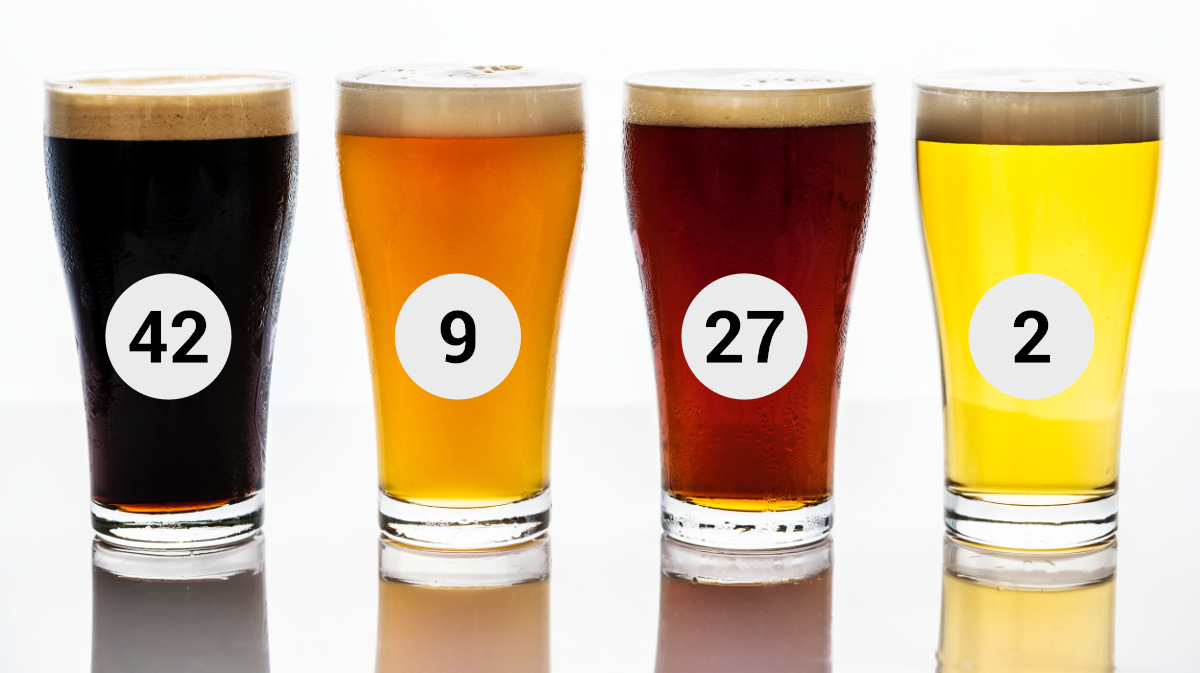
The most common value used in the US to measure beer’s color is the Standard Reference Method, or SRM scale for short. It was developed by the American Society of Brewing Chemists in 1950 as the scientific standard for identifying beer color.
The scale starts at 1 and goes up to 40+. Lower numbers mean lighter colors, while higher numbers mean darker colors.
The Range:
1–3 SRM: Pale straw to light gold (Pilsners, Light Lagers)
4–7 SRM: Amber to deep copper (Pale Ales, Amber Lagers)
8–15 SRM: Brown to dark brown (Brown Ales, Porters)
20–40+ SRM: Black to opaque (Imperial Stouts)
The Lovibond Scale
Lovibond also known as degrees lovibond or abbreviated as °L is a scale for measuring color originally introduced by Joseph Lovibond in the 1860’s. Lovibond color is approximately equivalent to the newer Standard Reference Method or SRM. Degrees lovibond and SRM may be used interchangably by homebrewers.
To determine color the sample is placed in a “Tintometer” which also contains several numbered discs of tinted glass. The Lovibond color is the value assigned to the disc whose color most closely matches the sample. The original Lovibond scale was used to measure gas colors, but has since expanded to measure the colors of oils, chemicals, foods and beverages.
For brewing, Lovibond is used primarily to specify grain colors – for example a dark roast malt might be 400°L, while a pale malt might only 2 or 3°L. In this application it is actually the color of a laboratory wort prepared from a sample of the malt under specified conditions whose color is determined. In older books, beer color may also be measured in Lovibond.

Other types of malts.
While all base malts are barley these days, not all barley becomes base malt. The recipe we cited earlier uses Munich Dark and Caramel Malt.
We mentioned that Munich is a type of base malt, so what is Munich Dark? It’s a darker version of the Munich malt that can also be a base malt, or can be used as a specialty malt due to its higher rating. Munich Malt is typically around 10°L , while Munich Dark can be as much as 20°L. Our recipe is using the Munich Dark as a flavoring and coloring agent. The darker color comes from the maltster allowing the grains to toast a bit longer to allow the Maillard effect to come into play. Think of the darkness control on your toaster. As the bread is toasted longer it gets darker and the taste is much different. Same with malting.
Caramel Malt adds distinct sweet notes of caramel, toffee, and toasted sugar. This is because it’s toasted longer, which develops the colors and addition sugars from enzymatic action in the grains.
he maltster has a lot of tricks used to create all sorts of different types of malt. Remember, the German Purity Law or Reinheitsgebot of 1516 only allows barley, hops, and water to be part of the bier on Bavaria! Brewers needed a way to add variety to their ;products. Malting processes helped them out.
Here’s a list of popular malts used in brewing:
- Biscuit & Victory Malts – Add dry toast and baked bread character.
- Aromatic & Melanoidin Malts – Boost malt aroma and rich malt depth.
- Honey Malt – Contributes sweet, honey-like flavor and golden color.
- Smoked Malts – Add subtle to bold smoke character.
- Dextrin Malts (Carapils/Carafoam) – Improve body and head retention.
- Acidulated Malt – Helps adjust mash pH and improve crispness.
Adjuncts?
Budweiser proudly states on every label, “Brewed by our original process from theChoicest Hops, Rice, and Best Barley Malt”. Hold on there! What about keeping to the German Purity Law‽ Well, Bud’s not brewed in Germany, and that rice is an adjunct grain.
Adjuncts are non-barley grains that are used in the brewing process to add flavor, mouthfeel, color, or even just to boost alcohol content. Our brown ale recipe calls for ¼ lb of flaked corn. That corn is an adjunct, used here to add a smooth and velvety mouthfeel.
- Unmalted Grains: Flaked oats, flaked corn, flaked wheat, and flaked rye. They add body, head retention, and unique flavor profiles to styles like Oatmeal Stouts or American Light Lagers.
- Sugars & Syrups: Honey, brown sugar, maple syrup, and dextrose. These are typically added to the boil or secondary fermentation to boost alcohol content without making the beer overly heavy or malty.
- Specialty Additions: Cacao nibs, coffee, fruit purees, and spices. These are often added post-fermentation to impart distinct, specialized characteristics.
As always, think of the end results when deciding which adjunct you may want to use, or none at all.
Summary
I hope this guide gives you a glimpse into the world of all-grain brewing. The style of beer you are after should determine the ingredients you use.
There are four main ingredients to ales and lagers: barley, hops, water, and yeast. Each of these have a wide variety of variations. Today we discussed barley. The two main types, six row and two row, each have different cultivars designed for specific beverage types. The work of the maltster in developing the color, flavor, and sugar profiles of the grain results in a vast spectrum of possibilities for the brewer.
Filling out your grain bill is as important as selecting the hops and yeast, and yes even the water to be used on brewday. Knowing what’s out there is a big help!
Happy Brewing!
Glossary
Adjunct Additional grains and sugars used in the brewing process
Base Malt the grains that make up the bulk of your recipe
Lovibond (°L) a scale used by brewers to measure and specify the color of a beer or malt.
Specialty Malt barley malts used to enhance the base malt flavor profile
Reinheitsgebot German Purity Law of 1516 only allows barley, hops, and water to be part of the bier on Bavaria, later revised to add yeast as the fourth fundamental ingredient.
SRM Standard Reference Method. It is the official scale used by brewers to measure and specify the color of a beer or malt.
Bibliography
DESALLE, R., TATTERSALL, I., & Wynne, P. J. (2019). A Natural History of Beer. Yale University Press.
BeerMaverick, What is the SRM & Beer Color Scale? © 2025 a Cagle Online Enterprises, Inc. Company, https://beermaverick.com/understanding-srm-and-lovibond-beer-color-calculations/
Brewwiki, Lovibond, the brewwiki, http://brewwiki.com/index.php?title=Lovibond&oldid=4721
CraftABrew.com, Specialty Malts, https://craftabrew.com/collections/specialty-malts?srsltid=AfmBOoqo0jIwZfPhIZXwJqbMr3lstMHERQXpPFZBPD1837lQ2nrPYqpw
Dornbusch, H. D. (2000). Bavarian Helles: History, Brewing Techniques, Recipes. United States: Brewers Publications.


Leave a Reply