“Nevertheless, their bitterness inhibits some spoilage in beverages to which it is added, making them last longer.” Hildegard von Bingen circa 1150
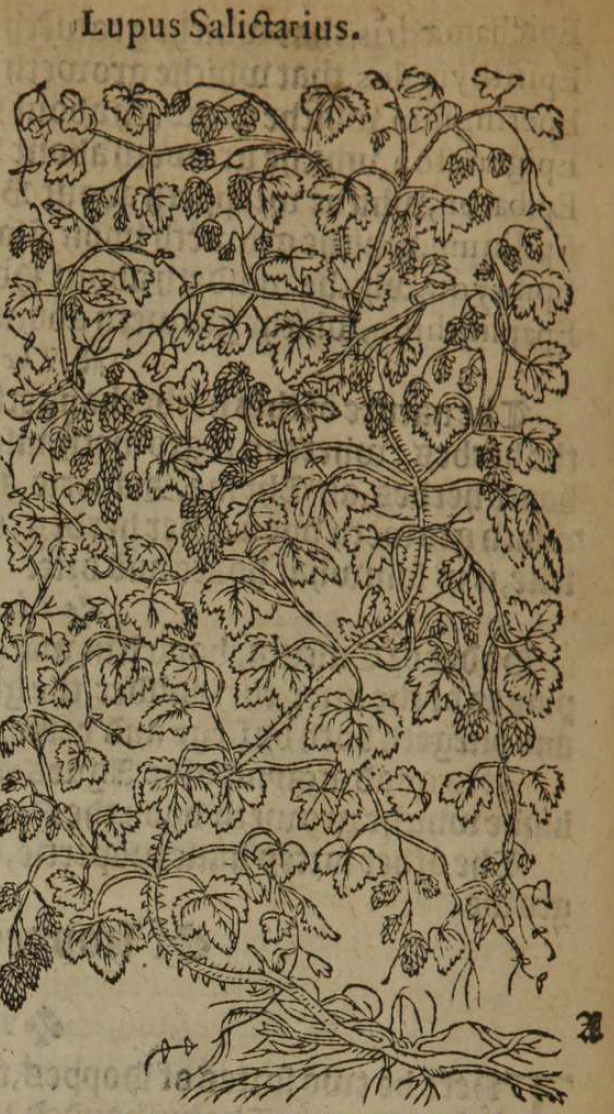
Hops are one of the three ingredients sanctified by the German Beer Purity Law of 1516, known as the Reinheitsgebot. Barley, hops, and water were all that were permitted (yeast was unknown, but added in the early 20th century). As we covered barley malt in a previous post, we will briefly focus on the history, uses, and different cultivars of hops here.
(Note: This is by no means intended to be a full dissertation on hops, simply an introduction.– Carrick)
Hops are the cone-shaped flowers of the Humulus lupulus. They are used to add bitterness, flavor, and aroma to beer. They balance the sweetness of malt and help preserve the beverage. Hops are a dioecious species; they have male and female plants. The male plant is largely unwanted. Fertilized female plants are useless to the brewing industry as the seeds produced create off flavors. The female’s cones contain yellow lupulin glands holding the essential oils and resins. These resins are what brewers need for their beer.
History of hops – where do they come from?
The modern hop has been developed from a wild plant as ancient as history itself. As far back as the first century AD they were described as a salad plant and are believed to originate from Egypt.(British Hops Association)
Wild hops are indigenous to temperate Europe, southwestern Asia, and North America. They naturally thrive in a specific latitude belt between 35° and 55°. The landacre hops we call “noble” are Hallertau Mittelfrüh from Bavaria, Tettnang from the Lake Constance region of Germany, Saaz from the Czech Republic, and Spalt from Nurnberg, Germany. Each of these varieties express different characteristics when added to the brewpot. Some are herbal, others spicy or earthy. All of them add a bitterness to the beverage, which offsets the sweetness of the malt.
Hops were thought to be medicinal.
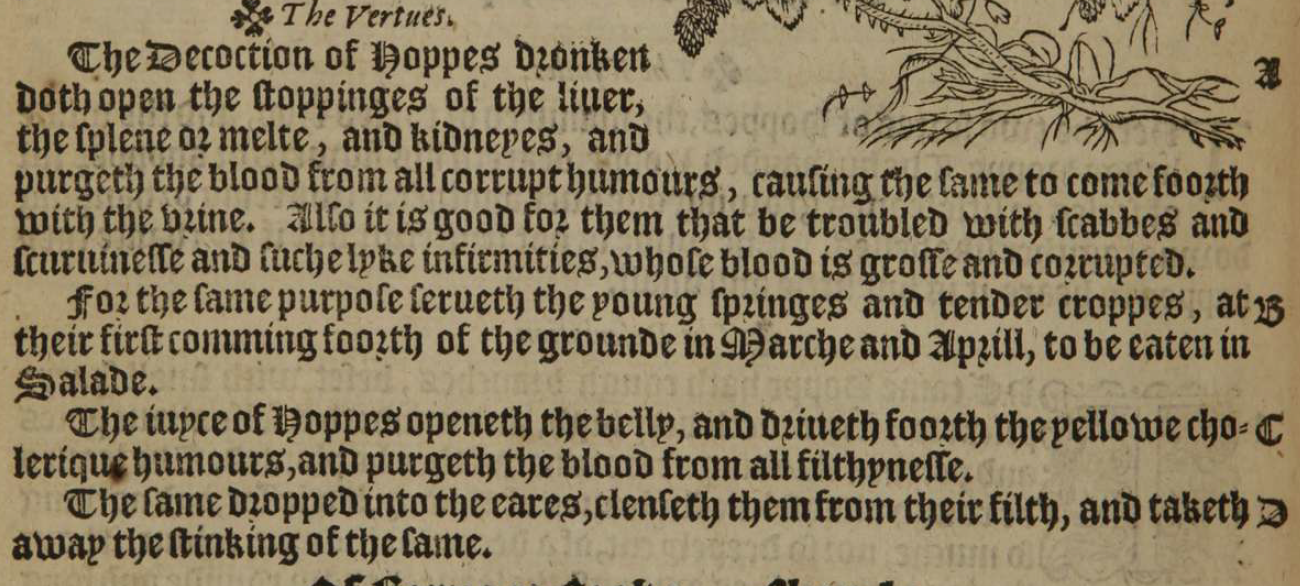
A New Herball, or Historie of Plants was published in the 16th century. It remained a widely used botanical guide for more than 200 years. In it, the virtues of hops are described:
The decoction of hoppes dronken doth open the stoppings of the liver, the splene or melte, and kidneys, and purgeth the blood from all corrupt humors, causing the same to come foorth with brine. Also it is good for them that be troubled with scabbes and scurvinesse and such lyke infirmites, whose blood is grosse and corrupted.
For the same purpose serveth the young springes and tender croppes, at their first comming forth of the grounde in March and April, to be eaten in Salad
The juyce of Hoppes openeth the belly, and driveth foorth the yellowe colerique humprs, and purgeth the blood from all filthyness.
The same dropped into the eares, clenseth them from their filth and taketh away the stinking of the same.(Dodoens)
St. Hildegard of Bingen, a 12th century German abbess, is responsible for the earliest surviving writings on the use of hops as a preservative in beer, and for that she has been venerated as an unofficial patron saint of beer. She believed that although hops provided preservative qualities through their bitterness, when ingested, “It is not much use for a human being, since it causes his melancholy to increase, gives him a sad mind, and makes his intestines heavy.”
Although it is less thought of a medicine today, hops do have antibacterial qualities, which we brewers take full advantage of.
Hops in brewing
Why use hops at all?
The lupulin from the cones contains oils and resins that contain acids, which become somewhat water soluble when boiled. These acids are the agents responsible for the preservative qualities, as well as the bitterness of hops.
The amount of alpha acid units (AAU) are used to show the bittering capabilities of a cultivar in a recipe. Looking at a few popular modern varieties, we can compare the alpha acid profiles with their use in brewing.
Admiral AA = 13-16%. Its bittering characteristics can be best described as assertive and resinous
Fuggles at 3.5-6.5% are described as well rounded, classic and green tea.
Target has an AA range of 8.5-13.5% and is sharp and aggressive.
East Kent Goldings at 4-6%, are sweet, smooth and honey-like. (BHA)
A more extensive list of British hops and their characteristics can be found at the BHA website.
AAU is calculated by multiplying the weight of the hops by the alpha acid content of the cultivar. This is helpful in determining how much hops to use in a given recipe.
Early hop users
Today, the words beer and ale mean much the same, beer being generally brewed with lager yeast and ale being brewed with ale yeast. The word ‘ale’ was originally reserved for brews produced from malt without hops. These ales were brewed with gruit – botanicals consisting of yarrow, meadowsweet, rosemary, ground ivy, or whatever was at hand to the brewer at the time. Ale was the original drink of the Anglo-Saxons and English, whereas ‘beer’, a brew using hops, probably originated in Germany. Hops were cultivated in the Low Countries (modern Belgium and Holland) from the 13th century.(ibid)
Early hopped beer was roundly rejected by English consumers. It was far more bitter than the ale or gruit available. However, the ability to have a brew last longer before spoilage was advantageous to the brewer. It allowed brewers to scale up production, and reduce the number of times it was necessary to brew over a given period. This freed the brewer, usually women or alewives, to commit to other household chores. So hopped ale, now called beer, as they do in Amsterdam, became the regular drink over time.
Medieval hop users
Eastern Europe and Bavaria show evidence of hop cultivation from the mid 8th century. The first evidence that is founded by documents, however, is dated on the 9th. century.(GFH) There is evidence of hop cultivation in Bohemia as early as 859 AD and it was definitely a valued commodity. Indeed, King of Bohemia, Wenceslas imposed the death penalty to everybody attempting to export any hop variety that could be used as new hop seedling. King Wenceslas the second (1278 – 1305) laid down only burghers in the royal town within the walls hold the right to brew.(CBA)
We see governments getting involved with brewing due to the ability to tax production. Once hops stabilized the product, taxation was soon to follow. Governments in general, and especially urban governments, were concerned with maintaining the quality of consumer goods. They did so to protect their own citizens, but if there was any potential for export, to insure a good name for their products in foreign markets.(Unger) Hops provided the “potential for export.”
When to use hops on brew-day
Hops make several contributions to the final beverage. They are used for bittering, flavoring, and to add aroma to your beer.
Bitterness
As we have been discussing, hops are bitter. This bitterness offsets the sweetness of the barley malt. As much as we try to extract as much of the fermentable and non-fermentable sugars from the grains, we also want to get as much of the bitterness from the hops as we can. We are (hopefully) trying to achieve a balance between bitter and sweet.
For this reason, we add our bittering hops at the beginning of the boil, just as we see the first walms arise. This gives the most time to exploit the resins as possible..
Flavoring
About halfway through the boil is a good time to add those hops used for flavoring. Boiling hops for too long will reduce the flavors they add to the beer. Boiling hops for too long will break down the essential oils responsible for flavor and aroma.
Aroma
Just as the boil completes, usually after an hour or so, add your aroma hops. You can determine, with your aroma hops, what you sense when you first lift the glass to appreciate the brew. Dry hopping is a method of adding hops later in the brewing process, specifically before or during fermentation, to add flavor and aroma without risking evaporating the essential oils during the boil. A drawback of dry hopping is risking the bitter/sweet balance. Hops with a high alpha acid content will tend to overpower the ratio and result in a much more “hoppy” brew. That is to say, there will be more citrusy, earthy, and spicy notes to your brew.
Summary
Hops have been around since prehistoric times. They were eaten in salads and believed to be medicinal is some ways. In the early medieval period, hops were found to have preservative properties that allowed for the exportation and trade of beer throughout the known world. Hops added a distinct balance to the sweet malt gruit, and also added a wide spectrum of flavors and aromas to beer. Through the cultivation of hops, and the governmental restrictions on beer production, regions such as Bavaria, Dortmund, and Bohemia became known for their specific beer styles.
Today we have the luxury of thousands of different hop cultivars to choose from, which add specific bitterness, flavoring, and aroma to our favorite beverage!
Glossary
AAU – a calculation of alpha acids for a recipe. AAU=weight of hops in oz x alpha acid %
alpha acids – The primary source of hoppy characteristics in beer.
beta acids – Contribute marginally to fresh bitterness, but mainly impact beer over time.
cultivar – a plant variety created through selective breeding.
dioecious – a plant with male and female individuals
Hops – the cone-shaped flowers of the Humulus lupulus. They are used to add bitterness, flavor, and aroma to beer.
landacre – a variety of plants that grow wild in a region
lupulin – glands holding the essential oils and resins.
Nobel hops – Hallertau Mittelfrüh from Bavaria, Tettnang from the Lake Constance region of Germany, Saaz from the Czech Republic, and Spalt from Nuremburg Germany
Reinheitsgebot – The German Beer Purity Law of 1516
walm – the first disturbance of the surface as a liquid begins to boil.
Bibliography
British Hops Association, https://www.britishhops.org.uk/hops/history/
Dodoens, Rembert, Niewe herball, 1517-1585 http://resource.nlm.nih.gov/2232003R
Hildegard von Bingen’s Physica : the complete English translation of her classic work on health and healing by Hildegard, Saint, 1098-1179, Internet Archive, 2023, https://archive.org/details/hildegardvonbing0000hild
GFH https://www.hopfenforschung.de/en/all-about-hops/history/
The Czech Beer Alliance (CBA), https://czechbeeralliance.co.uk/bohemian-brewing-history/
Unger, Richard W.. Beer in the Middle Ages and the Renaissance. Philadelphia, University of Pennsylvania Press, 2004.


Leave a Reply